Base44 for SMB Websites: Fit, SEO, AI Visibility, and Tradeoffs
Where Base44 fits for SEO and AI
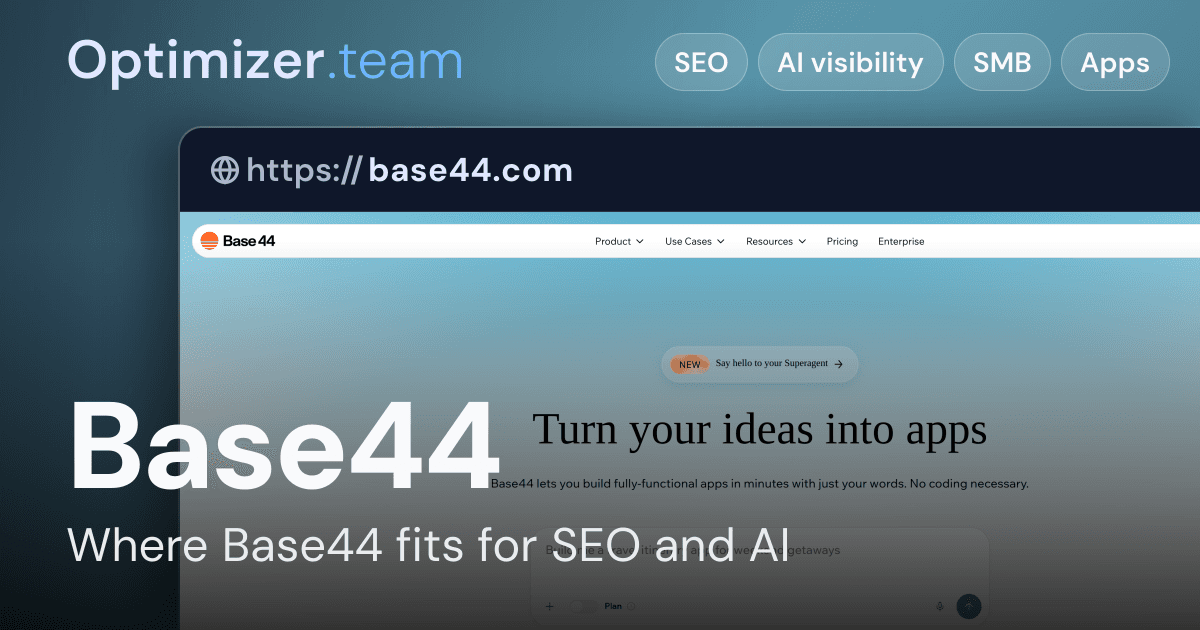
Base44 is the kind of platform that can make people ask the wrong question.
The wrong question is:
- is Base44 good or bad?
The useful questions are:
- what kind of business surface is Base44 actually good at?
- when does Base44 help a team move faster?
- where does it become a mismatch?
- how does it affect SEO, AI visibility, and content operations?
For some businesses, Base44 is a smart choice because it helps them ship a real public product quickly. For others, especially businesses that mainly need a conventional website or a content system, Base44 can be the wrong shape of platform even if it feels fast at first.
This page is the broad entry point. If you already use Base44 and want tactical implementation guidance, jump to Base44 SEO (GEO): Practical Guide to Getting Indexed in 2026.
Background and definitions: AI SEO overview.
What Base44 is, in practical terms
Base44 is best understood as a fast app-building platform, not just a classic website builder.
In plain English, that usually means:
- the platform is optimized for shipping functional product surfaces quickly
- the public experience often behaves more like a web app than a traditional marketing site
- speed and convenience are part of the appeal
- the team still has to decide what content should be public, indexable, and stable
That last point matters more than it sounds.
Many SMB website decisions are really content and workflow decisions. If the business mostly needs:
- a homepage
- service or category pages
- local trust signals
- articles or docs
- simple, predictable editing by non-technical teammates
then the platform should be judged partly as a content system.
Base44 can absolutely publish public pages. The question is whether your most important growth surface is a small public app plus a few core pages, or a more traditional website with broad informational coverage.
Who Base44 is a good fit for
Base44 is usually strongest when the business wants to ship an app-like public surface quickly and does not need a large content-first site.
1. SMBs with a lightweight public tool or utility
Examples:
- lead qualification tools
- instant estimate or quote flows
- calculators
- customer intake or booking workflows
- simple portals or dashboards
- interactive product explainers
If the main value is in the tool itself, Base44 can make sense because the site is not just explaining the business. It is doing part of the work.
In these cases, the public website can stay intentionally small:
- a clear overview page
- a pricing or plans page
- an FAQ page
- a docs or setup page
- the tool or app itself
That is a cleaner fit for Base44 than a business that needs dozens of SEO landing pages from day one.
2. Teams that care more about speed than deep CMS flexibility
Some businesses do not need an elaborate web stack. They need momentum.
Base44 can be a practical fit when the team wants:
- fast iteration
- a simple path from idea to published app
- fewer infrastructure decisions
- a public surface that can support demos, onboarding, or lead capture
For an operator who is trying to ship a working product this quarter, that tradeoff can be reasonable.
3. Product-led SMBs whose website is secondary to the app
For some SMBs, the website is not the main asset. The main asset is the product or workflow experience.
Examples:
- internal operations tools offered to clients
- niche SaaS products
- customer-facing estimators
- workflow automation tools with a public landing layer
In that situation, Base44 can fit because the public site does not have to be a full publishing machine. It just needs to explain the product clearly enough and support discovery for the highest-value pages.
Who should be cautious with Base44
Base44 is more likely to be a weak fit when the business problem looks like a website or CMS problem more than an app problem.
1. Content-heavy businesses
Be cautious if growth depends on:
- many long-form content pages
- large resource libraries
- ongoing editorial publishing
- location or service page expansion
- fine-grained control over page templates and content models
That kind of work is less about shipping a product interface and more about maintaining a durable, scalable content system.
2. Marketing-led teams that need predictable publishing workflows
If non-technical marketers need to:
- publish often
- manage structured content repeatedly
- maintain many landing pages
- update metadata and page structure with low friction
you should evaluate whether Base44 supports that workflow naturally or only indirectly.
The practical issue is not whether something is technically possible. It is whether the ongoing publishing workflow is clean and repeatable.
3. Businesses that depend heavily on rich public discovery
If your traffic strategy depends on:
- large numbers of discoverable pages
- strong social previews on many routes
- fast indexation of new pages
- stable non-interactive public content
- clean extraction by search and AI systems
then you need to think harder about how Base44 exposes those pages. A platform that is great for shipping an app is not automatically ideal for scaling a content-driven acquisition system.
Where Base44 is strong
The strongest case for Base44 is speed paired with focused scope.
Base44 tends to be compelling when a business wants to:
- launch a functional public tool quickly
- get a proof-of-concept live without a big engineering process
- keep the number of public pages intentionally small
- pair a product-like experience with a few strong explanatory pages
That combination can be enough for many SMBs, especially when the real buying decision happens after a demo, a quote flow, a consultation, or a product interaction.
For that kind of business, the right public surface may be:
- one strong homepage
- one focused pricing page
- one FAQ page
- one onboarding or docs page
- one interactive product surface
If that set of pages is clear, crawlable, and internally linked, Base44 can be workable.
Where Base44 becomes limiting
The things that make Base44 appealing early can become constraints later.
Base44 is more likely to feel limiting when the business needs:
- a large, content-first website
- many public pages with distinct intent
- deeper control over page rendering and public HTML
- predictable sharing previews across many routes
- a workflow optimized for marketing teams, not just builders
- a cleaner separation between marketing site and app surface
That does not automatically mean Base44 is the wrong platform.
It means the business should ask:
Are we trying to use an app builder as if it were our long-term CMS?
If the answer is yes, the friction you feel may not be tactical. It may be structural.
Is Base44 good for SEO?
It can be, but not by accident.
The strongest SEO argument for Base44 is that it can provide a technical baseline for public pages. The more important operational question is whether the site has enough high-quality public content to deserve indexing and rankings.
Many Base44 SEO problems are not really “metadata problems.” They are surface-design problems:
- too little public content
- too much reliance on interactive UI
- weak internal linking
- unclear page intent
- shallow trust and proof
- too few stable, indexable URLs
For many SMBs, the practical SEO job is to create a deliberate public surface that search engines can understand without guessing.
That usually means:
- a custom domain
- a crawlable homepage
- a pricing or plans page
- an FAQ page
- docs, setup, or use-case pages
- internal links between those pages
For the tactical version, use: Base44 SEO (GEO): Practical Guide to Getting Indexed in 2026.
Is Base44 good for AI SEO and AI visibility?
Potentially, yes, but the same caveat applies: the platform is only part of the story.
AI visibility depends on whether your public pages are easy to:
- discover
- parse
- summarize
- trust
That means AI visibility improves when you publish pages that are:
- answer-first
- explicit about what the business does
- clear about who the product is for
- specific about use cases and constraints
- supported by proof, screenshots, examples, or outcomes
If your Base44 site mainly exposes a generic shell and hides the useful explanation inside interaction, AI systems have less to work with.
If your Base44 site publishes a small set of clean, quotable, structured public pages, it can support GEO much better.
For broader framing, see AI Discovery Surfaces (AEO/GEO).
Base44 vs a traditional CMS or website builder
This is the comparison that matters most.
Choose Base44 when:
- the business has an app-like public experience
- the site can stay relatively small
- speed matters more than deep publishing flexibility
- the public surface exists to support the product, not replace a content system
- the team is comfortable thinking in product pages rather than classic website sections
Choose a traditional CMS or website builder when:
- the website itself is the main acquisition engine
- you need lots of content pages
- marketers need low-friction publishing
- the site is primarily brochure, service, editorial, or resource-driven
- repeatable page management matters more than app-like interactivity
That distinction is easy to miss.
Many teams are really deciding between two different jobs:
- ship a working app experience quickly
- run a scalable public website and content system
Base44 is usually better aligned with the first job.
Use cases for our ICP: where Base44 fits and where it does not
For time-constrained SMB owners, the best platform is not the most impressive platform. It is the platform that fits the real business job.
Good fit: a focused public utility
If the business uses the website to:
- qualify leads
- run an estimator or intake flow
- demonstrate a product
- support onboarding
- answer a limited set of buying questions
Base44 can be a sensible fit.
Mixed fit: local service businesses
For many local service businesses, the core discovery engine is still a mix of:
- Google Business Profile
- reviews
- trust signals
- service pages
- location relevance
If the business mainly needs a conventional website with clear service pages and proof, Base44 may not be the most natural long-term choice. A simpler website builder or CMS can sometimes fit that job better.
If you are local-first, pair this with Google Business Profile Optimization.
Mixed fit: SEO-led content growth
If the plan is to win traffic through many public pages, publish regularly, and expand topical coverage over time, Base44 deserves more scrutiny.
The question is not whether you can publish on Base44.
It is whether Base44 is the easiest place to run that publishing model month after month.
A simple decision framework
If you are deciding whether Base44 is a good choice, use this shortcut.
Base44 is probably a good fit when:
- the public surface is small and focused
- the main value comes from a tool, app, or interactive workflow
- the team needs speed more than deep template control
- SEO depends on a handful of high-quality public pages, not a large content engine
- the business can clearly separate what should be public from what should stay in-app
Base44 may be a weak fit when:
- growth depends on many indexable pages
- the website is more important than the app
- marketers need to publish often without friction
- social previews, content workflows, and public rendering need to be highly predictable
- the team is already compensating for platform shape instead of shipping value
What to focus on if you stay on Base44
If the business is staying on Base44, the best next move is usually not “more features.”
It is improving the public surface.
Prioritize:
- one clear overview page
- one strong pricing or plans page
- one visible FAQ page
- one docs or setup page that is readable without login
- clear internal links between the key pages
- visible proof and constraints
- consistent business facts and positioning
For Base44, clarity beats cleverness.
A smaller, clearer Base44 public surface is usually better than a larger, thinner one.
Best next step
Choose the next page based on the job you are trying to do:
- I already use Base44 and want tactical implementation guidance: Base44 SEO (GEO): Practical Guide to Getting Indexed in 2026
- I want the bigger picture on AI discovery: AI Discovery Surfaces (AEO/GEO)
- I want the foundation for AI-readable site structure: LLMs.txt Guide
- I am local-first and Maps matters more than my app stack: Google Business Profile Optimization
- I need a more traditional website builder comparison: Wix for SMB Websites
Final take
Base44 is not the best platform in the abstract, and it is not the wrong platform by default.
It is a better fit for businesses that need a fast, focused, app-like public surface than for businesses that need a classic CMS-driven website.
The right way to evaluate Base44 is not by asking whether it can technically publish pages.
It is by asking whether it matches the job your public surface actually has to do.
If it does, keep the public layer tight and intentional.
If it does not, recognize that early and choose a platform built for the website job instead.
FAQ
Sometimes, yes, but it depends on the kind of site you are trying to publish. Base44 is strongest when the business needs an app-like public experience, wants to ship quickly, and can think in terms of product surfaces rather than a traditional content-first website. It is less naturally suited to marketing-heavy sites that depend on large content libraries, editorial workflows, or highly predictable non-JavaScript rendering across many public pages.
Base44 is best for teams that want to launch fast, publish a focused public surface, and pair it with an interactive product, lightweight tool, client portal, calculator, or workflow app. It can be a strong fit for operators who value speed over deep CMS flexibility. It is less ideal for teams whose main need is a classic brochure site, a large blog, or a content operation run by marketers rather than builders.
Base44 can be workable for SEO, especially because its documentation emphasizes a technical baseline like sitemaps, robots.txt, canonicals, and clean public URLs. The bigger question is whether your most important pages are public, content-rich, internally linked, and clear enough to deserve indexing. For many Base44 sites, the limiting factor is not the platform alone. It is whether the site exposes a strong crawlable public surface instead of relying too heavily on interactive UI.
It can be, if you make your key public pages easy to extract and summarize. AI visibility depends less on whether the platform has AI features and more on whether your pages are crawlable, explicit, and trustworthy. Base44 can support that when you publish answer-first pages like overview, pricing, FAQ, docs, and comparisons, then keep your entity facts and proof consistent across those pages.
The main drawback is not speed at launch. It is what happens when the business needs a more content-heavy website system. If growth depends on many landing pages, editorial publishing, deep template control, or predictable rendering for every public route and preview bot, Base44 can start to feel like the wrong shape of platform. The more your growth model looks like a CMS problem, the more carefully you should evaluate it.
Choose Base44 when the business needs a lightweight app, utility, or interactive product surface and the website can stay intentionally small. Choose a more traditional CMS or website builder when the business mainly needs marketing pages, service pages, editorial publishing, and low-friction content updates by non-technical teammates. The right choice depends on whether your public surface is primarily an app or primarily a content site.
Yes. If organic traffic matters, a custom domain and a deliberate set of public pages are baseline requirements. Base44 can handle technical SEO foundations, but you still need to decide which pages should be indexable, how they are linked, and what they say. Without that public structure, the platform cannot create search or AI visibility on its own.